
 Shop
ShopPFA Injection and Blow Molding – Process and Application Characteristics
Jul
- PFA injection molding process parameters
PFA (perfluoroalkoxy) is a high-performance fluoroplastic that has found wide use in fields as diverse as chemical engineering, electronics, semiconductors and medical care, due to its excellent chemical, high-temperature and weather resistance, and low friction properties. Injection molding is a key process in the manufacture of PFA products, and the optimization of process parameters is essential for enhancing the quality and efficiency of PFA injection-molded products.
- Injection temperature
The selection of injection molding temperature should be made after careful consideration of factors such as the characteristics of PFA material, mold design, product requirements, and equipment performance. The injection moulding temperature range for PFA is typically between 350°C and 450°C. Temperature extremes have the potential to impact the fluidity of plastics, altering their melt viscosity and affecting the crystallinity and mechanical properties of the products.
- Injection pressure and injection speed
Injection pressure is the driving force that propels the resin into the mold, while injection speed controls the flow rate of the resin within the mold. Appropriate injection pressure and speed are essential to ensure the plastic fully fills the mould, avoiding defects such as air pores and shrinkage cavities, while also enhancing production efficiency.
- Holding pressure time and mold temperature
The holding pressure time refers to the period during which the resin cools and shrinks in the mould, and is of great significance for ensuring the dimensional stability of the product and reducing shrinkage deformation. The temperature of the mould directly affects the cooling rate of the plastic and the quality of the finished product.
- PFA blow molding process parameters
- Temperature
The blow-up temperature should be controlled between the glass transition temperature and the melting temperature. It is generally accepted that the optimal inflation temperature range is between 130°C and 190°C. If the temperature is below 130°C, a higher air pressure is required to complete the inflation process. However, it should be noted that excessively high air pressure may cause the PFA pipe to rupture. Should the temperature exceed 190°C, the tensile strength and elongation of PFA will decrease, but it will be susceptible to cracking.
- Air pressure
At an appropriate blowing temperature, the magnitude of the air pressure directly affects the blowing rate of the PFA pipe and the quality of finished PFA products. The magnitude of the air pressure is dependent on the diameter of the base pipe, the wall thickness and the required inflation rate. Increased wall thickness necessitates higher air pressure, and a smaller outer diameter will also require a higher air pressure.
- Blowing speed
If the blowing speed is too fast, it may cause the inner wall of the PFA pipe to become uneven or develop wrinkles, while if it is too slow, it may have a negative impact on production efficiency.
Injection molding is generally used to manufacture products with greater thickness and has comparatively lower requirements for raw materials. Conversely, blow-molded products are characterized by their thinness and transparency, and even minor defects are more apparent. Therefore, there are certain requirements for the toughness and tensile properties of the raw materials.
- Differences
- Molding principle
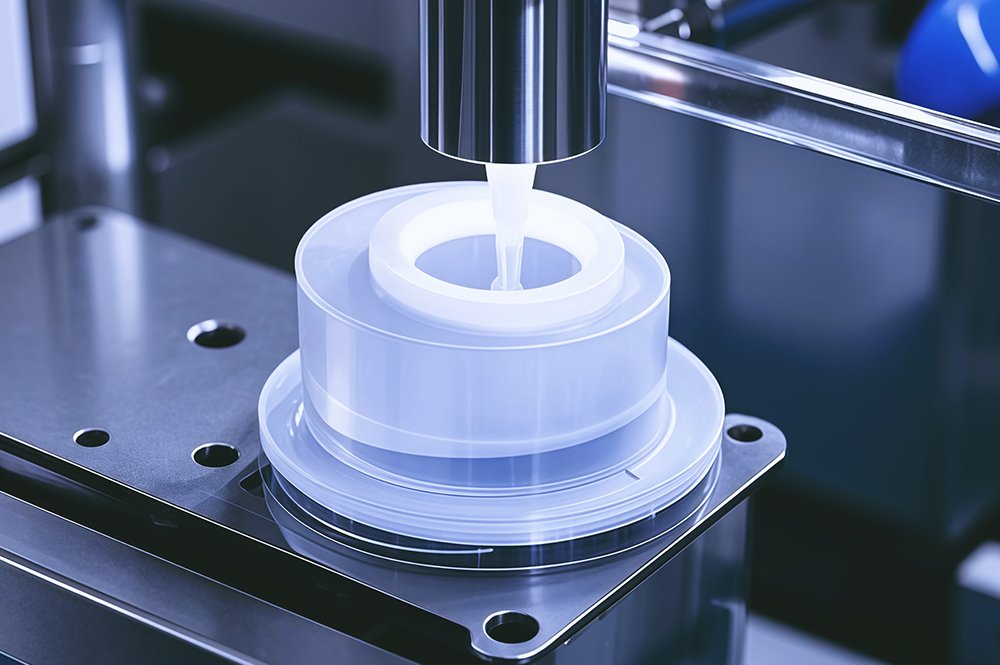
Injection molding is a process in which PFA particles are heated and melted by an injection molding machine and then injected into a mold. Following a cooling and solidification process, the desired product is obtained.
Blow molding is a process that involves heating and softening the PFA tube blank, placing it in a mold, and then introducing compressed air into the tube blank to make it expand and adhere closely to the inner wall of the mold. Following a cooling and solidification process, the desired product is obtained.
- Scope of application
Injection molding is an ideal process for the manufacture of complex-shaped and precisely sized products, such as PFA joints and valve housings.
Blow molding is particularly well-suited to the production of products with uniform wall thickness and hollow structures, such as bottles.
- Production efficiency
Injection molding is a highly efficient production method, with machines operating continuously and each mold cycle being brief.
The production efficiency of blow molding is relatively low due to the length of each molding cycle and the necessity of carrying out each blow molding operation individually.