
 Shop
ShopProcessing and Molding of PTFE Dispersion Resin
Jul
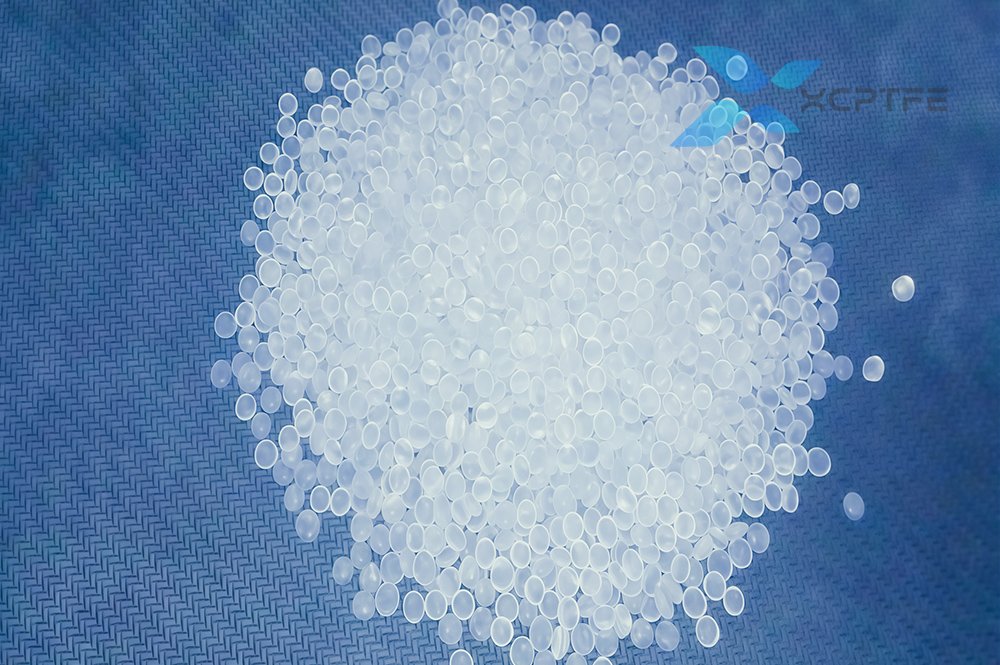
PTFE dispersion resin has a higher molecular mass and crystallinity compared to suspension PTFE resin, with a crystallinity level of 96% to 98%. In order to reduce resistance and prevent damage to the fibre structure of fine powder resin, it is necessary to apply shear force to the material during the extrusion process. This process requires the addition of a certain amount of extrusion aid to the resin. Typically, the extrusion aid is mixed evenly with PTFE fine powder to form a paste, which is then moulded into a preform. The preform is then added into the material cavity of the press and a certain thrust is applied. It should then be forced to pass through the opening at a constant speed to form the push-pressed semi-finished product of the required shape.
The semi-finished products, after undergoing treatments such as drying, sintering, quenching and cooling, eventually become PTFE extruded products with a certain degree of mechanical strength. The range of extruded products includes rods, tubes, strips, sheets and special-shaped parts, among others.
- Pipemolding
- Straight pipe forming
The paste formed by the mixture of PTFE dispersion resin and extrusion aid is then pressed into shape by a vertical press to obtain the raw pipe. The raw pipe is susceptible to longitudinal cracking when subjected to external forces, which necessitates the PTFE dispersion resin to possess a high degree of fiber-forming property. This is of particular importance when it comes to the moulding of large-diameter pipes.
PTFE raw tubes are subjected to a sintering and quenching treatment, which results in the acquisition of specific mechanical strength. Consequently, these tubes are designated as inner tubes. PTFE inner tubes are primarily used as pipelines for transporting high and low-temperature liquids or corrosive media. Key requirements for the materials include density, durability, and consistency in strength across both the longitudinal and transverse axes. Additionally, they must exhibit flexibility within the tube body and demonstrate optimal bending fatigue performance.
- Pressurehose
PTFE pressure hoses are a type of pipe material that is capable of withstanding high temperatures, high pressures and highly corrosive liquid or gas media. The pressure hose is composed of three parts: a PTFE inner tube, a steel wire reinforcing layer and a metal joint.
- PTFE inner tube
According to the usage characteristics of PTFE pressure hoses, they are filled with various liquids and gases under certain pressure and mostly operate in a bent state. Therefore, the PTFE inner tube in the pressure hose must have low permeability and a high bending life. This requires that the void content in the inner tube after the PTFE resin is sintered be as low as possible.
- Wire coating forming
The extrusion process for processing PTFE dispersion resin into wire coating is essentially analogous to the forming process of pipes. The process entails extracting the metal wire from the wire laying device, straightening it using the tensioning wheel, and then inserting it into the hollow core mold.
The application of pressure via the pushing plunger initiates the formation of the PTFE preform through the die. The preform is subjected to a pushing force on the surface. The metal wire coated with PTFE is pushed out from the die and enters the drying furnace to remove the extrusion aid before being sent to the sintering furnace.
During the high-temperature sintering process, the powder particles of PTFE dispersion resin are fused together to form a coating layer with specific properties. Due to the flexibility of PTFE wires, the layout of the drying and sintering furnaces does not have to be in a straight line; a U-shaped design can be adopted. This approach allows for the reduction of equipment height, while simultaneously increasing forming speed.
- Strip forming
- Elastic strap
The PTFE film is then dried after calendering to remove all the extrusion aids, and undergoes low-ratio stretching to increase its strength. It is important to note that the stretching temperature of this material is lower than its melting temperature, and it is generally advisable to take 310 to 320 degrees Celsius. The stretched PTFE membrane possesses a degree of elasticity and strength, thus classifying it as an elastic membrane. When it is divided into a specific width, it is referred to as an elastic tape.