
 Shop
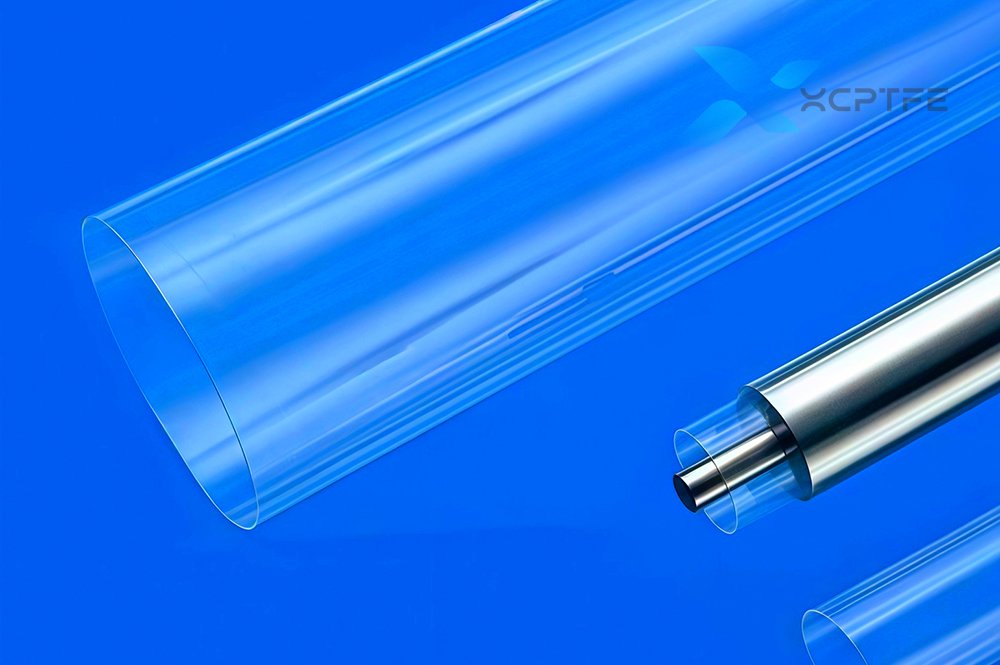
ShopWhy FEP Tubes Offer Greater Transparency Than Other Fluoroplastics
Apr
- The unique molecular structure of FEP material
The transparency of fluoroplastics is directly related to the arrangement of their molecular chains. The molecular chain of FEP is formed by alternating copolymerization of tetrafluoroethylene (TFE) and hexafluoropropylene (HFP), with precise regulation of the proportion of the two monomers (typically, the HFP content is 15%-20%). The structure of FEP enables the formation of a microstructure dominated by amorphous states, where molecular chains are stacked loosely, thereby reducing the diffuse reflection of light within the material.
By contrast, the crystallinity of PTFE (polytetrafluoroethylene) ranges from 90% to 98%, with its molecular chains arranged in a tight helical pattern. The light passing through the PTFE material causes it to scatter intensely at the interface between the crystalline and amorphous regions, resulting in the milky white appearance of PTFE. The crystallinity of PFA (perfluoroalkoxy resin) is lower than that of PTFE (approximately 50%-70%), but its long side chain structure still forms some crystal regions, so its transparency can only reach a semi-transparent state.
- The influence of FEP tube processing technology
The processing temperature range of FEP is substantially lower than that of PTFE. During the extrusion molding process, the rapid passage of the FEP melt through the cooling water tank results in the molecular chains being frozen before they can be arranged in an orderly manner, thereby further inhibiting the crystallization process. Laboratory data shows that the crystallinity of FEP tubes can be controlled below 5%, while the crystallinity of PTFE tubes still exceeds 50% even when the rapid cooling process is adopted.
This process also allows for precise control of wall thickness. FEP tubes maintain transparency even at wall thicknesses of 3mm, while PFA tubes experience significant fogging when the thickness exceeds 1mm. A test report from a leading semiconductor equipment manufacturer reveals that, under equivalent thickness conditions, the transmittance of FEP at 450nm blue light reaches 92%, while PFA and PTFE exhibit 78% and 35% transmittance, respectively.
- Properties of FEP tubes
FEP, while maintaining transparency, perfectly inherits the excellent properties of fluoroplastics.
- Chemical stability
Its resistance to strong acids and alkalis is comparable to that of PTFE. Following a 1,000-hour immersion in 98% concentrated sulphuric acid, there is only a 2% reduction in light transmittance.
- Heat stability
Its long-term operating temperature range is -80°C to 200°C, and it is capable of withstanding a short-term high temperature of 260°C.
- Surface characteristic
It has a coefficient of friction that is comparable to that of PTFE.
These features position FEP tubes as a critical component in special scenarios. For instance, in the field of biopharmaceuticals, the transmission of drug solutions requires full visual monitoring throughout the process, and at the same time, the tubes must be able to withstand high-temperature sterilization and highly corrosive cleaning agents.
- Precise adaptation to the applications of FEP tubes
The transparency of various fluoroplastics dictates their applications.
- Medical catheters
FEP, with its transparency and biocompatibility, has become the preferred choice for endoscopic cannulas and extracorporeal circulation pipes.
- Semiconductor etching
The utilization of FEP tubes during the conveyance of high-purity chemicals allows operators to undertake direct observation of bubbles and particles through the tube walls.
- Photovoltaic industry
The use of FEP film as the solar back cover is intended to guarantee light transmittance and ensure weatherability.
PTFE is more frequently used in scenarios where transparency is not a requirement, such as in seals and bearings. PFA, on the other hand, is frequently used in storage tanks for corrosive liquids that need semi-transparent observation.