
 Shop
ShopPTFE Straight-Through Joints | Key Advantages Over Other Materials
Jul
- What is PTFE?
PTFE is an acronym for Polytetrafluoroethylene, a synthetic polymer material. It is polymerized from tetrafluoroethylene monomer and exhibits extremely strong chemical inertness, excellent temperature resistance and good corrosion resistance. The wide range of properties that PTFE exhibits have resulted in its extensive use in industrial contexts, particularly in scenarios where corrosion resistance, high-temperature durability, and minimal friction are paramount. It is frequently utilized in seals, pipe linings, valve packing, and various connecting parts.
- What is a PTFE straight-through joint?
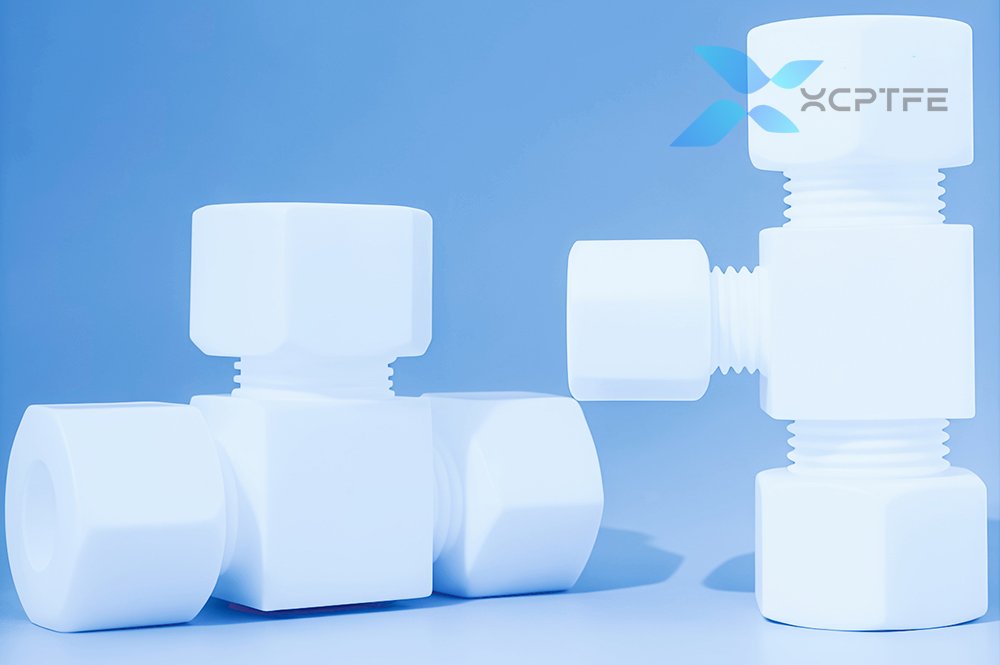
PTFE straight-through joints, also known as polytetrafluoroethylene straight-through joints, and Teflon straight-through joints, are pipe connection components made of PTFE material. Its core function is to achieve linear connections in the pipeline system, ensuring the sealing and directionality of the fluid during the transportation process. Unlike metal joints, PTFE straight-through joints are entirely made of fluoroplastics, avoiding the risk of metal ion precipitation contaminating the fluid.
- The features of PTFE straight-through joints
- Strong corrosion resistance
PTFE material hardly reacts with any chemical substances and is suitable for conveying systems containing strong corrosive media such as acids, alkalis and solvents.
- Excellent resistance to high and low temperatures
PTFE can be stably used within the temperature range of -80℃ to 260℃, meeting the application requirements under extreme temperature conditions.
- Low coefficient of friction
PTFE surfaces are renowned for their smoothness and extremely low coefficient of friction, which helps to reduce the resistance of the fluid at the connection points and improve transmission efficiency.
- Good electrical insulation
PTFE exhibits excellent dielectric properties, making it well-suited for applications that demand high levels of electrical insulation.
- The applications of PTFE straight-through joints
Chemical industry: It is used for conveying corrosive media (such as sulfuric acid and sodium hydroxide), and does not require frequent replacement during long-term operation.
Pharmaceutical industry: It meets the high hygiene requirements of media such as liquid medicine and purified water, and prevents contamination and chemical reactions.
Food processing: It can convey raw materials such as fruit juice and sauce, which complies with food safety standards and has a smooth surface that is easy to clean.
Environmental protection engineering: It is able to withstand the corrosion of fluorine-containing waste gas condensate, thereby extending the service life of the system.
- Comparison between PTFE straight-through joints and joints made of other materials
In industrial applications, common materials for pipe joints also include stainless steel, PVC, PEEK, etc. In comparison with these materials, PTFE straight-through joints offer distinct advantages.
- Compared with stainless steel
While stainless steel boasts higher strength, it is susceptible to corrosion in strong acid and strong alkali environments, while PTFE performs more stably.
- Compared with PVC material
PVC is a more cost-effective option, but its heat and chemical resistance is significantly lower than that of PTFE.
- Compared with PEEK material
PEEK boasts higher mechanical strength and high-temperature resistance, though it is expensive. In contrast, PTFE is a more cost-effective solution.