
 Shop
ShopHow Are PTFE Tubes Made? Inside the Extrusion Molding Process
Sep
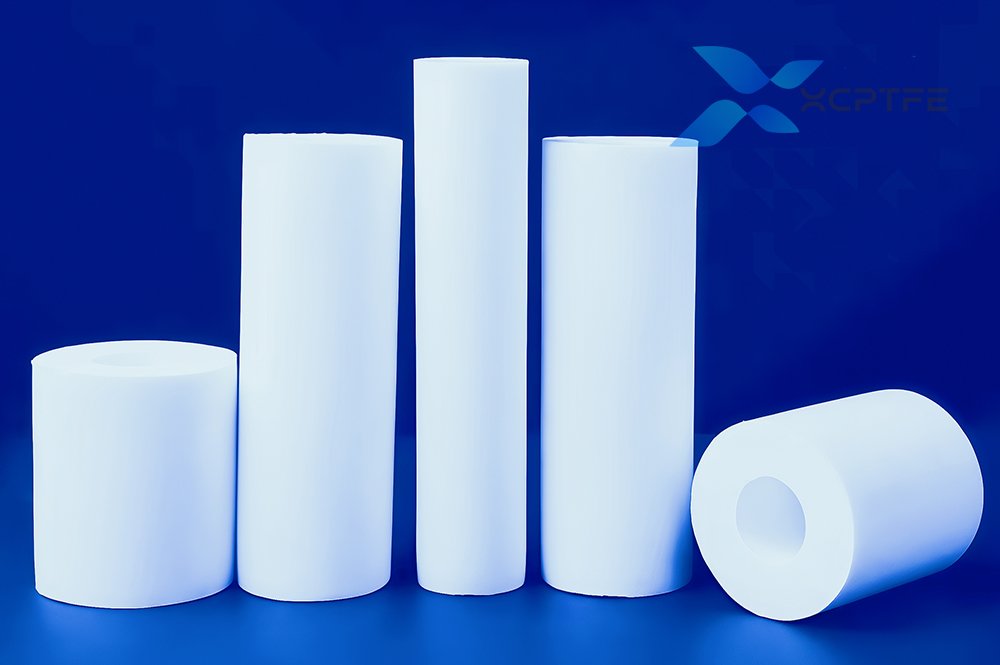
PTFE material is not able to melt and flow in the same way as the PVC or PE materials. It can only be transformed into a continuous and dense tubular structure through a special process involving paste extrusion and high-temperature sintering. The following discussion will elucidate the process of extrusion molding of PTFE tubes, providing a comprehensive overview of the transformation from powder to tubes.
- Pretreatment of raw material
The initial step in the PTFE tube extrusion process is the utilization of high-purity PTFE fine powder as opposed to ordinary granular materials. This resin powder is characterized by its lack of fluidity, which precludes its direct formation.
- Precise proportioning and mixing
The PTFE fine powder must be mixed with the extrusion aid in a strict proportion. Its function is to lubricate powder particles, thereby reducing the friction between them and enabling the transformation of loose powder into soft, extrudable paste-like materials.
- Removingimpurities and drying
The paste is subjected to a sieving process in order to remove impurities. Thereafter, the paste is dried at a low temperature with a view to eliminating residual moisture. Moisture has been shown to form pores during subsequent sintering, which can severely damage the density and mechanical properties of the tubes.
- Preforming
The pre-treated paste cannot be fed directly into the extruder. Initially, the raw materials undergo a pre-forming process that involves the transformation of the loose paste into dense and uniform tubular green bodies, a process that prepares them for the subsequent high-pressure extrusion.
- Feedingand pressing
Fill a certain amount of paste into the vertical/horizontal preforming mold, apply high pressure through a hydraulic press, and maintain the pressure for several minutes.
- Compactingand venting
When exposed to high levels of pressure, the air within the paste is expelled, resulting in the close stacking and interlocking of the PTFE particles. This process leads to the formation of a tubular green body that is devoid of any gaps and exhibits certain strength. At this stage, despite the appearance of a tubular structure of the materials, the particles are merely united through physical extrusion, resulting in a state of comparative low strength and considerable fragility.
- High-pressure extrusion molding
A plunger extruder is used to load the preformed tubular materials into the extruder barrel. The hydraulic plunger is then activated to slowly push the materials forward under extremely high pressure. Under pressure, the PTFE particles are rearranged and pushed into continuous tubular semi-finished products.
- Drying and removing extrusion aid
Semi-finished tubular products that have just been extruded still contain a large amount of extrusion aids. If the sintering process is conducted directly, the extrusion aids will evaporate rapidly, resulting in the generation of a significant number of pores. This will lead to the tubes becoming loose and cracking. Consequently, the removal of extrusion aids by drying is imperative.
- High sintering
- Precise temperature control during sintering
Following this, the dried tubes are sent into a high-temperature sintering furnace and heated at an extremely slow rate to 360-380℃ (higher than the melting point of PTFE at 327℃), where they are maintained at a constant temperature for 2-4 hours.
- Particle fusion and crystallization
At the sintering temperature, the surface of PTFE particles begins to melt and diffuse with each other. The originally independent particles then gradually fuse into a continuous and gap-free whole. Concurrently, the PTFE molecular chains undergo a restructuring process, resulting in the formation of a stable crystalline structure. This leads to a substantial enhancement in the mechanical strength, temperature resistance and density of the tube.
- Slow cooling and shaping
Following sintering, it is essential to cool the material slowly in the furnace. This is to avoid internal stress caused by excessive temperature difference, which may lead to deformation or cracking of the tubes. It is only after cooling to room temperature that the tubes truly exhibit the excellent properties of PTFE.
- Post-processing and quality inspection
- Dimension adjustment
The tube is trimmed to the designed length through processes such as cutting and turning, and the burrs and ellipticity at the tube opening are corrected to ensure that the inner and outer diameters, wall thickness and straightness meet the standards.
- Full quality inspection
Conduct dimensional inspection, wall thickness measurement, pressure testing, airtightness testing, and corrosion resistance testing on the tubes to ensure that there are no pores, cracks, impurities or other defects, and that the performance meets the required standards.
The rigorous and complex extrusion molding process is precisely what transforms the originally loose PTFE powder into continuous, dense and high-performance tubes. It is designed to maximize the characteristics of PTFE, including resistance to high and low temperatures, corrosion resistance, low friction and excellent insulation. It is capable of producing long-sized, thin-walled and high-precision tubes, meeting the strict demands of high-end fields such as chemical pipelines, medical catheters, electronic insulation and aerospace.