
 Shop
PTFE Evaporating Dish | Corrosion-Resistant Evaporation Guide
Oct
In the context of chemical laboratories, environmental monitoring stations, and the analysis rooms of pharmaceutical enterprises, evaporation stands out as a critical yet seemingly simple process. In order to concentrate the sample solution to a certain volume or to evaporate the liquid to obtain solid residue for analysis, a classic vessel is indispensable: the evaporating dish.
Traditional evaporating dishes are typically made of glass or ceramic, and are highly effective in most standard applications. However, in the case of highly corrosive liquids, such as hydrofluoric acid and aqua regia, glass and ceramic containers may not be suitable, as glass is susceptible to corrosion from hydrofluoric acid, and ceramic surfaces can be damaged by strong alkalis. At this point, a special type of evaporating dish becomes the optimal choice: PTFE (polytetrafluoroethylene) evaporating dish.
- What is a PTFE evaporating dish?
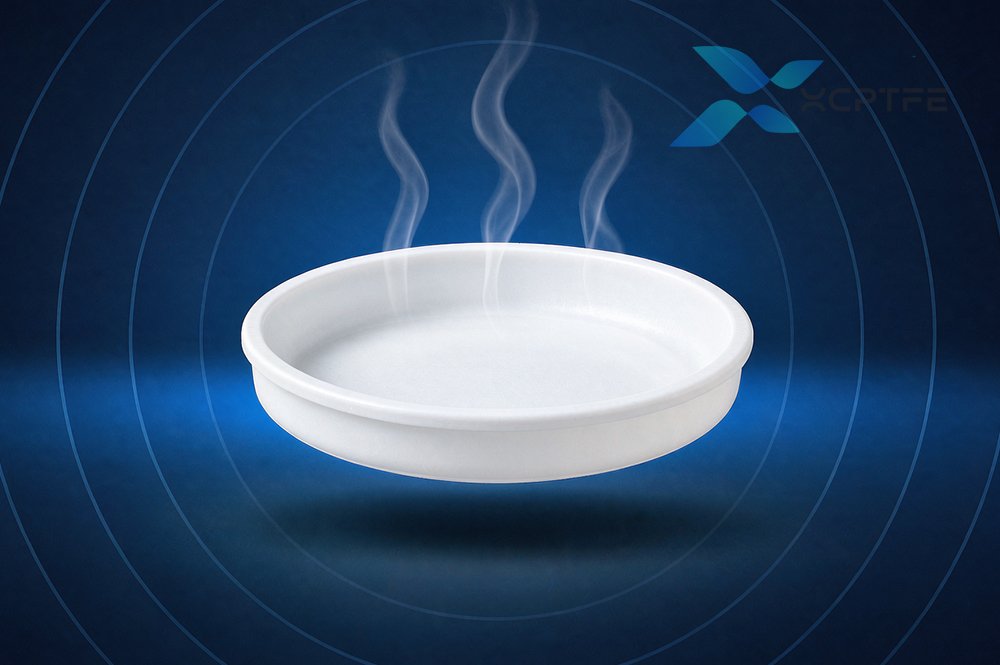
PTFE evaporating dishes are laboratory evaporators made of high-purity polytetrafluoroethylene material. It is circular in shape, with a concave middle. This classic design is conducive to the uniform accumulation and evaporation of liquids. The surface of the evaporating dish has been carefully refined and meticulously polished, ensuring optimal ease of cleaning and facilitating the full recovery of solid residues after evaporation.
- Core features
- Resistance to high and low temperatures
PTFE evaporating dishes are engineered for reliable performance across a wide temperature range, with a stability that ensures long-term use from -200 °C to +250 °C. This means that, whether it is high-temperature evaporation and concentration using an electric heating plate or freeze-drying in a low-temperature environment, it can maintain good mechanical properties.
- Strong corrosion resistance
This is the most notable feature of PTFE evaporating dishes. It is resistant to strong acids, strong alkalis, aqua regia, hydrofluoric acid and most organic solvents. It is also important to note that when evaporating hydrofluoric acid, glass or quartz dishes will be severely corroded, while evaporating dishes made from PTFE are unaffected. This feature makes it an ideal choice for operations involving hydrofluoric acid, such as in geological sample pretreatment and silicon material analysis.
- No dissolution, no adsorption, no precipitation
PTFE material is characterized by its exceptional chemical stability, which prevents dissolution, adsorption or precipitation when exposed to various corrosive media. During the evaporation process, the dish is designed to release no impurities into the sample and will not adsorb the effective components of the sample. This characteristic is of vital importance for trace analysis and the preparation of ultra-pure substances.
- Main application fields
- Geological and environmental monitoring
In the pretreatment of soil, rock and water samples, hydrofluoric acid is often required to decompose silicate samples. PTFE evaporating dishes are the ideal containers for withstanding the corrosion of hydrofluoric acid.
- Petrochemical engineering
In experimental contexts, such as oil product analysis and catalyst evaluation, it is necessary to evaporate a variety of organic solvents and corrosive media. PTFE evaporating dishes are well-suited to this task.
- Chemical industry
From synthesizing fine chemicals to analyzing basic chemical raw materials, evaporation concentration is a routine operation, and PTFE evaporating dishes are reliable tools for the handling of corrosive samples.
- Pharmaceutical and food inspection
In the processes of drug residue analysis and the detection of food additives, evaporation concentration constitutes a significant step in sample pretreatment. PTFE evaporating dishes have low adsorption characteristics which ensure the complete recovery of trace substances.
- Comparison with glass and ceramic evaporating dishes
In comparison with traditional glass or ceramic evaporating dishes, the key benefit of PTFE evaporating dishes is their ability to resist hydrofluoric acid and strong alkali. Glass evaporating dishes are susceptible to severe corrosion when exposed to hydrofluoric acid, while ceramic evaporating dishes may experience gradual damage when subjected to strong alkali. However, PTFE evaporating dishes demonstrate no reaction to either of these two types of corrosive media.
Furthermore, the non-stick properties of PTFE evaporating dishes facilitate the recovery of samples. The solid residue left after evaporation is often difficult to remove completely from glass and ceramic surfaces. However, when using PTFE evaporating dishes, the residue is less likely to adhere and can be collected more completely.
It should be noted that PTFE evaporating dishes are not without their limitations. Its maximum operating temperature is lower than that of ceramic evaporating dishes, so it is not suitable for operations that require extremely high temperatures for burning. At the same time, the price of PTFE evaporating dishes is higher than that of glass or ceramic evaporating dishes with the same specification.