
 Shop
The Role of PTFE Buckets in High-Purity Chemical Storage and Transport for Semiconductor Manufacturing
Nov
Wet electronic chemicals used in the semiconductor manufacturing process have extremely high requirements for the control of metal impurities and particle contamination. PTFE barrels play a pivotal role in the storage and transportation of high-purity chemicals. Their primary function is to ensure the integrity and purity of the materials during these processes.
Firstly, the corrosion resistance of PTFE is adapted to these occasions. Many high-purity chemicals, including hydrofluoric acid, strong acids, and highly oxidizing cleaning solutions, have the potential to corrode glass and quartz, and also easily lead to impurities being precipitated from stainless steel and ordinary plastics. PTFE has strong chemical inertness and does not react with such high-purity chemical liquids at room temperature. This ensures that the PTFE container itself will not be corroded or produce particles.
The second advantage is low background and low precipitation. High-purity PTFE raw materials are free of fillers, and the dissolution of heavy metals and non-metallic impurities is extremely low. The process is designed to avoid the introduction of harmful metal ions, such as sodium, iron, and copper, into the liquid, thereby ensuring the absence of defects in components. The inner wall of a PTFE bucket is not sticky, which makes it difficult for trace components in the chemical liquid to adsorb and adhere to the wall. Following material changing and cleaning procedures, the residue is manageable, thereby reducing the risk of cross-contamination between batches.
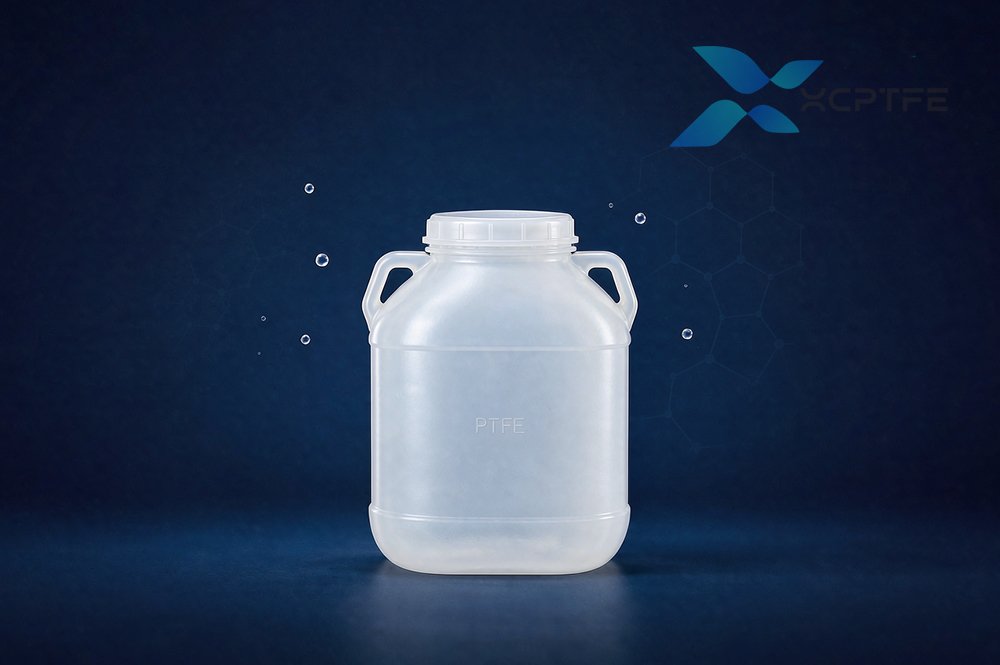
In the transfer process, it is primarily used for the transfer of small-batch high-purity liquid medicine, sampling, and short-distance transportation within workshops. This application differs from that of large storage tanks. Many processes require the transfer of small quantities of photoetching, etching, and cleaning reagents between different procedures. PTFE buckets are integrally formed, reducing the risk of particle contamination. They satisfy the stringent requirements for particle control in clean workshop environments.
The most common materials stored and transported in PTFE drums are various strong corrosive acids and alkalis, including hydrofluoric acid, concentrated nitric acid, aqua regia, concentrated alkali solutions, etc. Hydrofluoric acid is able to corrode glass, and strong oxidants can also cause ordinary plastics to release impurities when they are in contact with them over an extended period of time. PTFE is an ideal solution for the stable storage of such reagents. Secondly, its versatility extends to storing various digestion solutions, geological and environmental pretreatment sample solutions. Many test solutions for ICP-MS trace analysis are stored in PTFE buckets temporarily, in order to prevent metal impurities from dissolving, which could otherwise raise the background.
In addition, it is capable of holding most organic solvents and strong oxidizing reagents. It is also suitable for the transfer and storage of high-purity chemicals, as well as semiconductor and wet electronic chemicals. For samples that are prone to adsorbing on the surfaces of other materials, storing them in PTFE buckets can reduce adsorption losses and ensure sample stability.
However, there are also applicable boundaries to consider: the permeability issue of PTFE cannot be ignored, and some small-molecule organic solvents will slowly penetrate after long-term storage. Its weak pressure-bearing capacity means it cannot be used for high-pressure liquid storage applications. The cost is relatively high, so the PTFE buckets are generally not adopted in long-distance transportation of large quantities of raw liquid. Its primary applications include use in laboratories, research and development processes, small sample verification, and precise transfer scenarios between processes.
PTFE buckets are primarily used for the storage of small samples of high-purity corrosive solutions, the transfer of materials during clean processes, and the interim storage of samples. They effectively prevent impurities and particle contamination from the containers, ensuring the cleanliness of semiconductor chemicals.